


Could you briefly introduce yourself and share what you’ve been doing since graduating from MUIC?
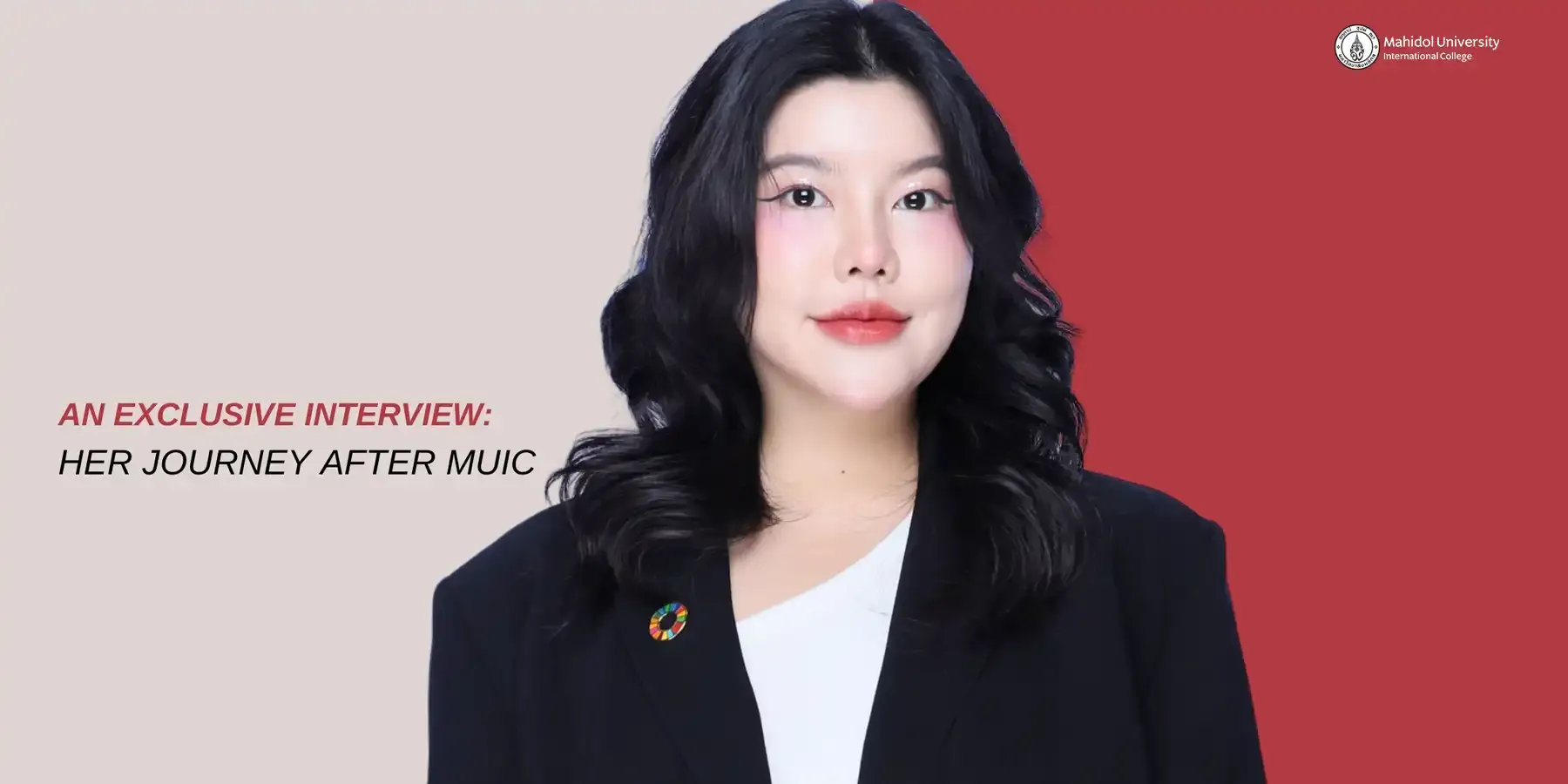
My name is Gansuda Goodngong (Pommie), and I graduated from MUIC with a degree in Intercultural Studies and Languages. Since then, my journey has taken me across different sectors and countries, shaped largely by curiosity about how systems work and how communication shapes the way people understand them.
After MUIC, I pursued a Master’s degree in International Development at the University of East Anglia in the UK, where I focused on issues such as inequality, power and governance, and global development systems.
Today, I work as a Global Internal Communications Manager at East-West Seed, where I help translate complex strategies and transformation initiatives into communication that resonates across countries, cultures, and teams. My role sits at the intersection of strategy, culture, and communication, ensuring that people across the organisation understand not only what is changing, but why it matters.
What inspired you to pursue Intercultural Studies and Languages as your major and what aspects of the programme resonate with you most?
I was drawn to Intercultural Studies largely because of my upbringing. I grew up abroad and was exposed to many cultures from a young age, which made me naturally curious about how people from different backgrounds communicate, interpret the world, and interact with one another. I often noticed that many conflicts begin with the smallest misunderstandings, particularly cultural ones, and that communication plays a crucial role in bridging those gaps.
At MUIC, the programme gave me a framework to better understand those dynamics. It was also an intellectually exciting space for me. I was the kind of student whose hand was often already in the air; asking questions, challenging ideas, and engaging actively in discussions.
What resonated with me most was how interdisciplinary the programme was. We studied philosophy, feminism, postcolonial discourse, and cultural theory, which encouraged us to examine identity, language, and power not as isolated topics but as interconnected systems. These subjects helped me think more critically about the structures and narratives that shape societies and influence how people see themselves and others.
In many ways, Intercultural Studies helped me see the world with greater clarity. Instead of viewing cultures as a blur of differences, it trained me to understand individuals within their contexts – shaped by history, language, and social structures. That way of thinking has stayed with me ever since and continues to influence how I approach communication and navigate diverse environments in my professional life.
During your time at MUIC, you participated in volunteer and international experiences. Could you share how those experiences influenced your decision to pursue International Development?
During my fourth year at MUIC, I joined a volunteer programme teaching English to underserved children in rural communities in Penang. It was one of the first moments when the ideas we discussed in class became real for me. I was no longer reading about inequality or access in theory. I was seeing how education, language, and opportunity directly shape a child’s future.
When that programme ended and I returned home, one of the first thoughts that crossed my mind was: what qualifications or training would I need if I wanted to help people professionally? That question stayed with me and became the starting point for the next stage of my academic journey.
Around the same period, I also had the opportunity to work briefly with UNESCAP during another academic break. That experience exposed me to the institutional side of development; how policy language, frameworks, and priorities influence decisions at scale. I began to see that behind every programme or initiative is a narrative that defines what is considered important or urgent.
These experiences made me want to understand those systems more deeply, which ultimately led me to pursue a Master’s degree in International Development.
Could you tell us more about your current role in global communications and what your work involves?
Today, I work as a Global Internal Communications Manager at East-West Seed, a global agricultural company focused on improving the livelihood of smallholder farmers through high-quality vegetable seeds and agricultural knowledge. In my role, I focus on translating complex strategies and organisational transformation initiatives into communication that people across the company can understand and engage with.
Our organisation operates across multiple countries, cultures, and professional contexts – from headquarters teams to field staff and laboratory technicians. Because of this diversity, my approach to communication always begins with the audience. I try to understand who they are, what their work environment looks like, and how cultural context might influence the way they interpret a message.
In agriculture especially, there is often a significant gap, not only in geography but also in digital access, literacy levels, and the way information is received. Designing communication that works across these realities requires messages to be thoughtful, accessible, and adaptable to different formats. Meaningful communication needs to go beyond simply sharing information. It needs to create clarity, alignment, and a shared understanding of where the organisation is heading.
A large part of my role therefore involves shaping narratives around change and helping people understand not only what is happening, but why it matters. In many ways, the intercultural and systems-thinking perspectives I developed during my studies continue to guide how I approach this work everyday.
What has been one of the most challenging moments in your journey, and how did you overcome it?
One of the more challenging moments in my journey was stepping into the corporate world after completing my studies. At that stage, I had always imagined myself working within the development sector, and I associated corporate environments with priorities that felt quite distant from the social impact work I cared about.
However, my twenties became a period of exploration. I have always believed that you cannot confidently reject something you have never fully experienced. Instead of avoiding the corporate world, I decided to step into it and test my own assumptions.
What I discovered was that organisations, regardless of sector, are systems shaped by structures, incentives, and power dynamics. Within any systems, some voices naturally carry more influence than others. Communication, when used thoughtfully, can help rebalance that dynamic. It can provide clarity where there is uncertainty and create space for perspectives that might otherwise go unheard. In that sense, communication can be a powerful tool for inclusion when it is designed with intention.
That realisation helped me see my work through a different lens. Rather than viewing corporate and development as separate worlds, I began to understand that the analytical and intercultural perspectives I developed through my studies could be applied in many different environments.
As an Ambassador of One Young World, what does this role mean to you both personally and professionally?
In 2023, I had the opportunity to attend the One Young World Summit in Belfast, Northern Ireland, as one of the delegates representing Thailand. The experience was a meaningful turning point for me because it expanded the way I think about impact and leadership. Before that, I had often viewed the world through a more binary lens – corporate on one side and development or social impact on the other.
What the One Young World community showed me is that these worlds do not have to exist in opposition. Many of the leaders and delegates I met were working in corporations, governments, and organisations while still actively driving meaningful change in their communities and industries. That experience helped me realise that impact can take many forms, and that meaningful work can exist within spaces I might not have previously associated with social good.
Personally, it reinforced my belief that leadership begins with responsibility – the responsibility to use your voice, your platform, and your expertise in ways that contribute positively to society.
Professionally, it gave me a broader perspective on how organisations can be part of larger conversations about sustainability, equity, and long-term impact. It reminded me that the systems we work within can also be spaces for learning, influence, and change.
How do the intercultural and systems-thinking perspectives you developed at MUIC influence the way you approach communication today?
My studies taught me to think about communication not simply as the exchange of information, but as something that shapes how systems function. The courses I took at MUIC encouraged me to examine how language, narratives, and structures influence whose voices are heard and whose perspectives may be overlooked.
That perspective continues to shape the way I approach communication in my work today. When designing messages, I try to think beyond the content itself and consider how different audiences might interpret it based on their cultural context, professional environment, or access to information.
This means asking questions such as: who might feel represented in this message, and who might feel excluded? How might someone from a different cultural background interpret the same wording? Are there perspectives we might be unintentionally overlooking?
In this way, communication becomes more than simply delivering information. It becomes a way of creating understanding across differences and ensuring that narratives within organisations remain inclusive rather than one-dimensional.
Ultimately, the analytical lens I developed through my studies continues to guide how I approach communication – as a tool that can influence systems, shape perspectives, and help bring diverse groups of people into a shared conversation.
If you could go back and give advice to yourself as a MUIC student, what would you say?
I would probably remind myself that it is okay not to have everything figured out yet. And that it is even more than acceptable to go out with friends every once in a while.
When we are students, there is often a lot of pressure from ourselves to define a clear career path early on. Looking back, I realise that many of the experiences that shaped me most came from curiosity and exploration rather than a perfectly planned trajectory and long hours of solely studying.
I would also encourage myself to continue asking questions and engaging deeply with ideas – something MUIC encouraged through its interdisciplinary approach. Those habits of curiosity and critical thinking turned out to be far more valuable than any single career plan.
In many ways, the willingness to step into unfamiliar spaces and test my own assumptions is what ultimately helped me grow, both personally and professionally.
What message would you like to share with current students or recent graduates who are still exploring their path?
It’s completely normal to feel uncertain about your path, especially in the early stages of your career. Not everything will make sense immediately, and that’s okay. Even after graduation, you’re still a baby learning how to be an adult for the first time in your life.
What helped me most was staying curious and being willing to explore spaces that I initially felt unsure of. Sometimes we form strong opinions about certain industries or career paths without ever experiencing them firsthand. Giving yourself the opportunity to test those assumptions and learning quickly from both successes and mistakes can be incredibly valuable.
I’ve come to appreciate the idea of failing fast and learning faster. Exploration inevitably comes with missteps, but each experience adds clarity and flavour about what matters to you and how you want to contribute.
I would also encourage students to take the time to understand how the world works – the systems, structures, and narratives that shape people’s lives and theirs. The more clearly you see those dynamics, the better equipped you will be to navigate different environments and contribute meaningfully wherever you choose to work.
In the end, careers rarely unfold in perfectly straight lines. Often, it is curiosity, openness, and the willingness to learn that quietly guide you toward the work that feels most meaningful.
Motto:
“Fortune favours the bold”
Ms. Gansuda Goodngong
MUIC Class of 2019
Major: Intercultural Studies and Languages
Position: Global Internal Communications Manager (IHQ), East-West Seed/ Ambassador of One Young World/ HLD Advisory Board
The Untold Story – MUIC Alumni Chapter 28|PDF