


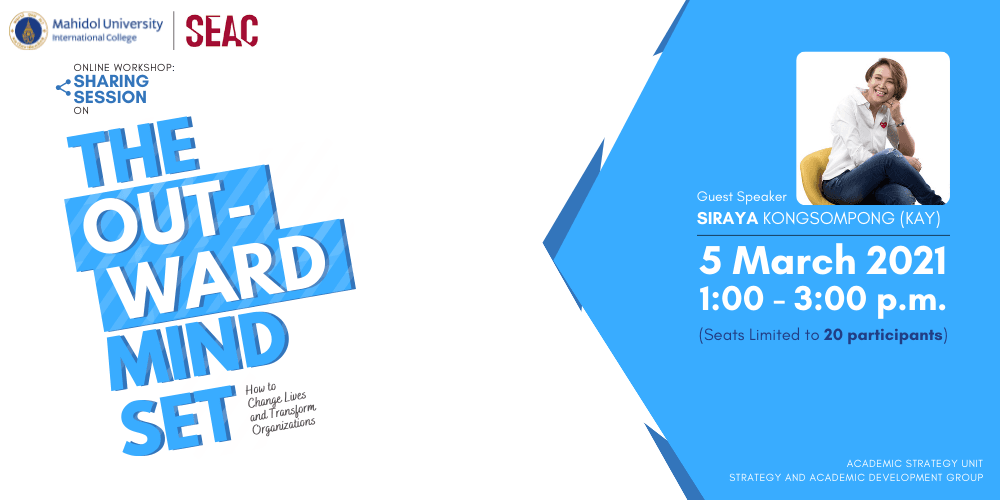
Title: The Outward Mindset
Date & Time: Friday, 5 March 2021 from 1.00 - 3.00 p.m.
Conductors: Dr. Siraya Kongsompong, SEAC
The Strategy and Academic Development Section and the Business Administration Division organized the 10th workshop for the academic year of 2020-2021 entitled ‘The Outward Mindset’. The workshop aimed to help participants understand two mindsets and their implications on our relationship with others, and how can changing mindset transform our lives and organization.
In the new economic era, silo-mentality is not the answer anymore. At some point, we all need support, input or resources from other people. Especially in organization, our relationship with others affect not only our own work or our team, but also the organization as a whole. Thus, to increase organizational efficiency and performance, the successful organizations tend to put emphasis on people collaboration in every levels; organization, group, and individual as good teamwork leads to a task that will more likely be finished on schedule, and to a higher standard. When we understand one another’s role, and value each input and effort they make in achieving the organization’s goals, everyone will likely hold themselves more fully accountable and have a deep commitment to one another to driving success.
Mindset goes beyond our personal belief. It not only defines the way we think and perceive the world, but it is also the reason behind our decisions and behaviors. Although, trying to change behavior is a fast approach, but without addressing the underlying mindsets, the attempt to change is likely to fail. To enable change within individuals, groups and organization, it is very important to understand what mindset really means and how it shapes the way we approach things and impact others and the world around us. Basically, there are two types of mindsets: inward mindset and outward mindset. With an inward mindset, we focus on ourselves and our needs. We see others as objects whose value depends on the extent to which their abilities are able to help us achieving our goals. When living with inward mindset, the individual tends to defense his/her position at all time, resulting in constantly looking for faults in others, and therefore blaming them for mistakes. With an outward mindset, on the other hand, we see others as people whose needs, goals, and struggles matter to us. It allows us to see beyond ourselves, and concentrate on what we need from others and what they might need from us to achieve the collective goal. Developing an outward mindset helps us to learn how to recognize the issues our organization is facing rather than focusing on personal goals. It provides an opportunity for everyone to identify mutually beneficial objectives, and measure our impact on the team, which eventually lead to working together, sharing knowledge, and positively influencing others to change. To develop an outward mindset, it involves the three foundational steps called S.A.M.
- S stands for See others. This means we need to strive to understand others’ needs, goals, and challenges in any situation.
- A stands for Adjust efforts. It’s about taking action to help others achieve their objectives.
- M stands for Measure impact. It involves measuring and holding oneself accountable for the impact of own work on others. It determines the effectiveness of our actions to see whether it can help others in the way they need to be helped.
One of the challenge to shift to the outward mindset is linking your own mindset change to change in others. People with an inward mindset tend to blame their struggles and their own mindsets on others, as they believe that having inward mindset is a way to defend themselves against others who have an inward mindset. It is really important to understand that at its most basic level, a change to an outward mindset can still transform your life and your relationships. People, therefore, are encouraged to adopt an outward mindset even when others around them persist in inwardness. In addition, most people have an impression that by practicing an outward mindset, you become vulnerable and pushover especially when dealing with aggressive inward-mindset people. However, what really put people at risk is not an outward mindset, but rather having your head down and self-focusing. Metaphorically, it’s like using mobile phone in public where people could be safer if they are putting their phones away and stay aware of what is happening around them.
Regardless of position or title, we sometimes experience a toxic environment, whether in personal life or in organization. Especially in toxic workplace, you will second guess yourself and question your ability to succeed. You’ll be put in survival mode at all times in order to survive a workplace that tries to sabotage you in every occasions. These are a sign of destructive relationships between the employees and dysfunctional workplace. By addressing the conflicts, self-assessing the extent to which you are working with an inward-mindset, and changing your mindset to become more outward, could make a big difference to yourself and your organization as a whole. Equipped with this understanding, you will recognize the needs of others, and know that everyone contributes their portions to accomplishing the collective result and constantly adjust themselves to achieve a better outcome, as much as you. And that’s when the true power of individual and team are unleashed and flourished.