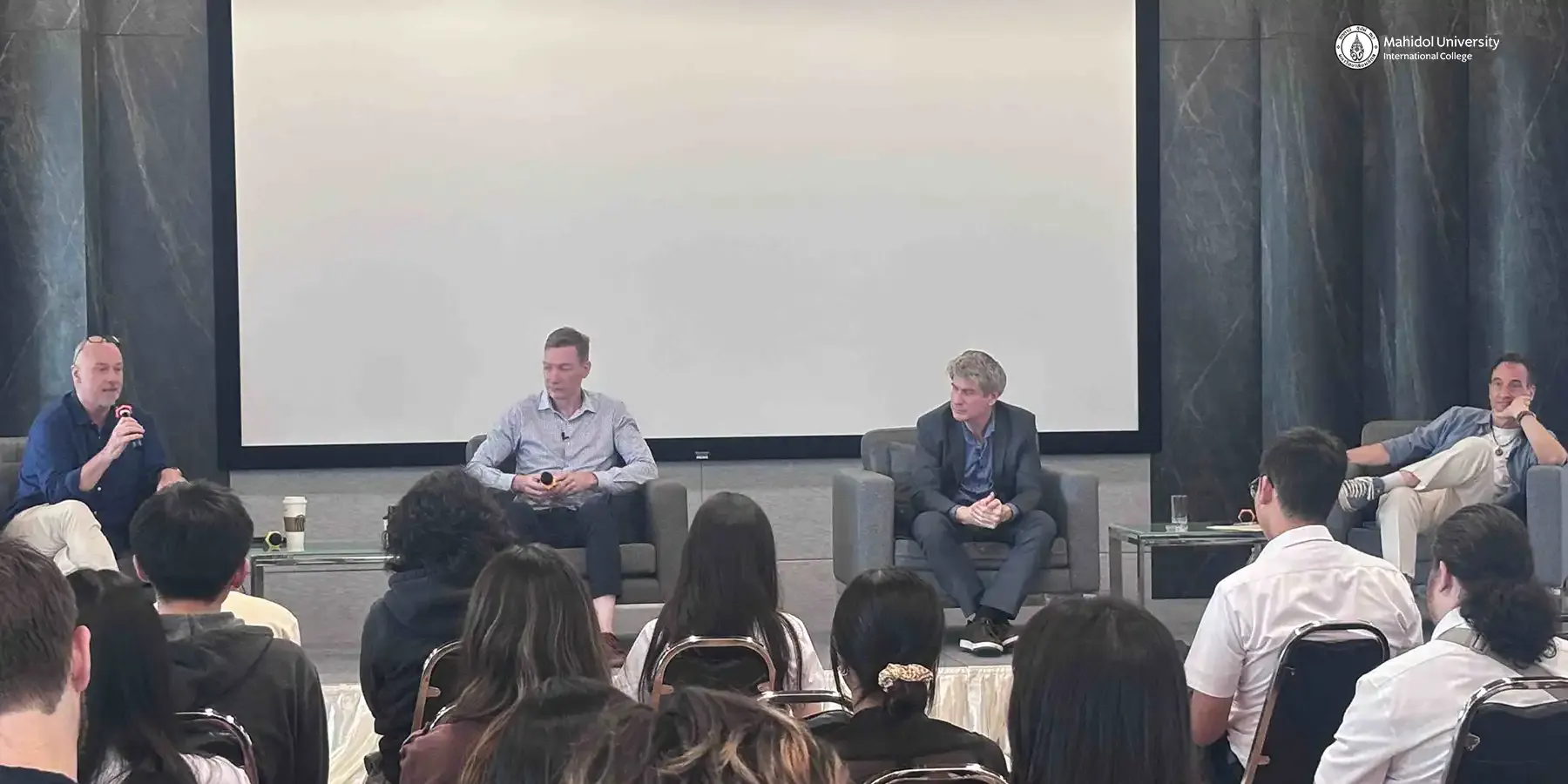



Amid a global landscape marked by rising tensions and new forms of conflict, three philosophy professors convened at Charinyarasami Hall, Aditayathorn Building on June 4, 2026 to dissect the complex and often-uncomfortable questions surrounding the morality of conflict. The panel discussion, titled "Ethics in Times of War," navigated the treacherous terrain between stark realism and enduring idealism, questioning the very values that guide human action when faced with the brute force of war.
The discussion featured Asst. Prof. Dr. Nahum Brown, Asst. Prof. Dr. Gerald Moshammer, and Asst. Prof. Dr. Daniel Pellerin, who brought perspectives from thinkers like Plato, Kant, and Foucault to bear on contemporary challenges. Serving as the moderator was Asst. Prof. Dr. York Gunther, Program Director of the Ethics, Philosophy, and Economics Concentration of the Humanities and Language Division (HLD).
Dr. Brown initiated the dialogue by establishing a fundamental framework for ethical evaluation: the distinction between instrumental and intrinsic values. "Are there even actions you take for the sake of themselves, or are your actions a means toward some further end?" he asked the audience. He explained that in times of war, life becomes "saturated with instrumental value," where people, resources, and actions are all viewed as tools to achieve a strategic goal.
Referencing thinkers from Aristotle to Martin Buber, Dr. Brown argued that philosophy offers a crucial antidote. "Philosophy offers a special type of freedom that elevates us above the limited perspective that in time of war may cause," he noted.
Dr. Pellerin offered a more sobering, realist perspective. "The world is just the way it is; you can't change it," he stated, but quickly added, "We can actually make it work." Citing the ancient Athenian maxim, "The powerful do what they can and the weak suffer what they must," Dr. Pellerin challenged the audience to look beyond the external successes of leaders and nations. He invoked Plato's The Republic and the biblical question, "For what shall it profit a man, if he shall gain the whole world, and lose his own soul?" to probe the internal cost of power, asking of the world's successful figures, "How balanced or aligned are they?"
Dr. Pellerin compared the modern citizen's perspective to being trapped in Plato's cave, where decisions are made with limited information and understanding. Yet, he held out a sliver of optimism, noting Plato's hope for a "philosopher-king."
Dr. Moshammer provided a sweeping historical and geopolitical context, tracing the evolution of warfare's ethics. He observed a shift from the pre-World War II "War of Conquest" to the era governed by the 1947 Geneva Convention. However, he argued that the nature of conflict is shifting once again.
"We are seeing the advent of a multipolar world as US hegemony is weakening," Dr. Moshammer said. "New tools of war in the form of AI and drones are being introduced. Hostilities are now initiated without formal declaration of war." He noted that while conquerors of the past were open about their ambitions, the modern justification is often to "protect democracy." This evolving landscape, he concluded, makes a clear moral compass harder to find, stating, "The ethics of war is the most difficult to attain."
A powerful theme emerged regarding the profound disconnect between policymakers and the populace. "The ruling class has no regards on the effects of war, especially to innocent casualties. They don't care," Dr. Moshammer stated bluntly, asking the rhetorical question, "Will war improve the life of an ordinary citizen?"
Dr. Brown echoed this sentiment, describing the feeling of being "overcome by getting dragged by those in power to a war that is not of their own choosing," a helplessness compounded by the overwhelming power of modern technology.
As the discussion concluded, the panelists turned to potential solutions, focusing not on grand political treaties but on individual transformation. "How to avoid war?" Dr. Pellerin proposed. "Make yourself a better person. Get a good education."
Dr. Brown brought the conversation back to the role of philosophy in preserving our core being. He argued that engaging with these difficult ethical questions, even when answers are elusive, serves a vital purpose. In the long run, he concluded, this intellectual and moral struggle "keeps us human."