


Title: Writing Teaching Cases I: Framing the Storyline
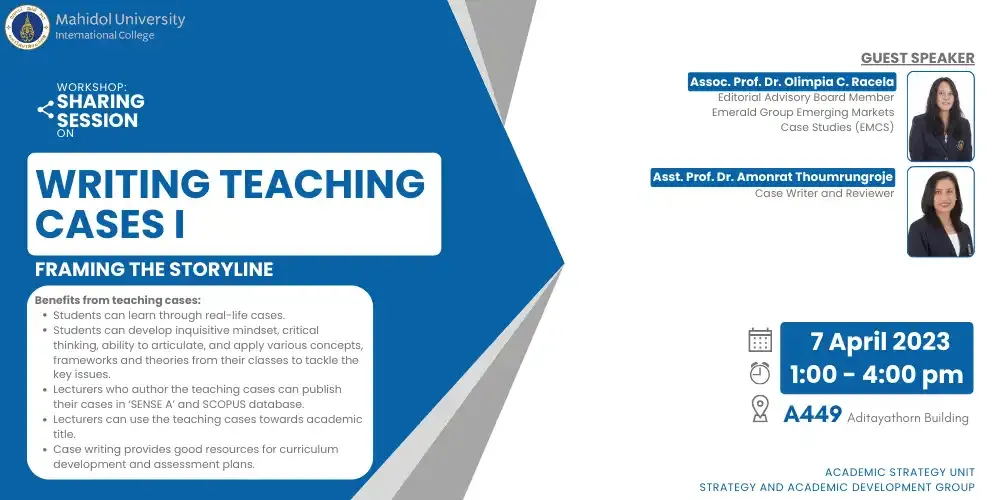
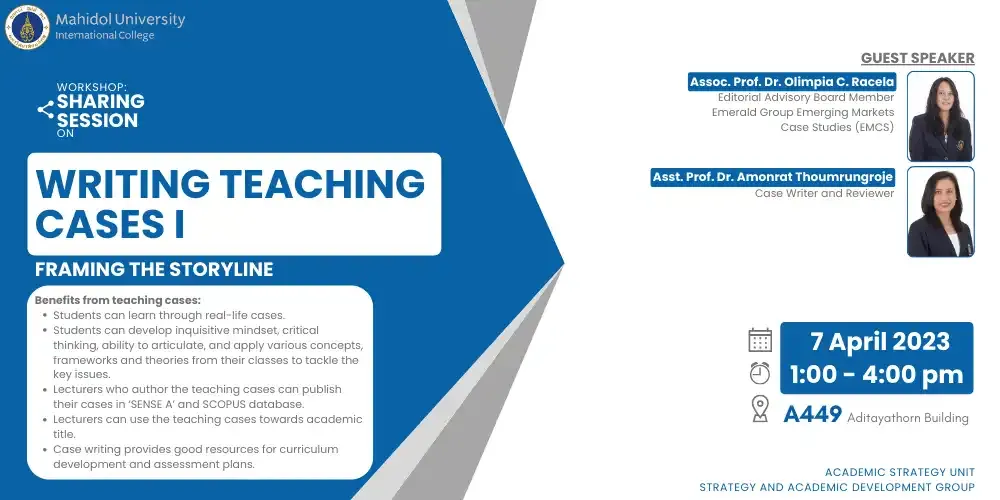
Date and Time: Friday, April 7, 2023, from 1:00 to 4:00 p.m.
Venue: A449, Aditayathorn Building
Conductor: Assoc. Prof. Dr. Olimpia C. Racela and Asst. Prof. Dr. Amonrat Thoumrungroj
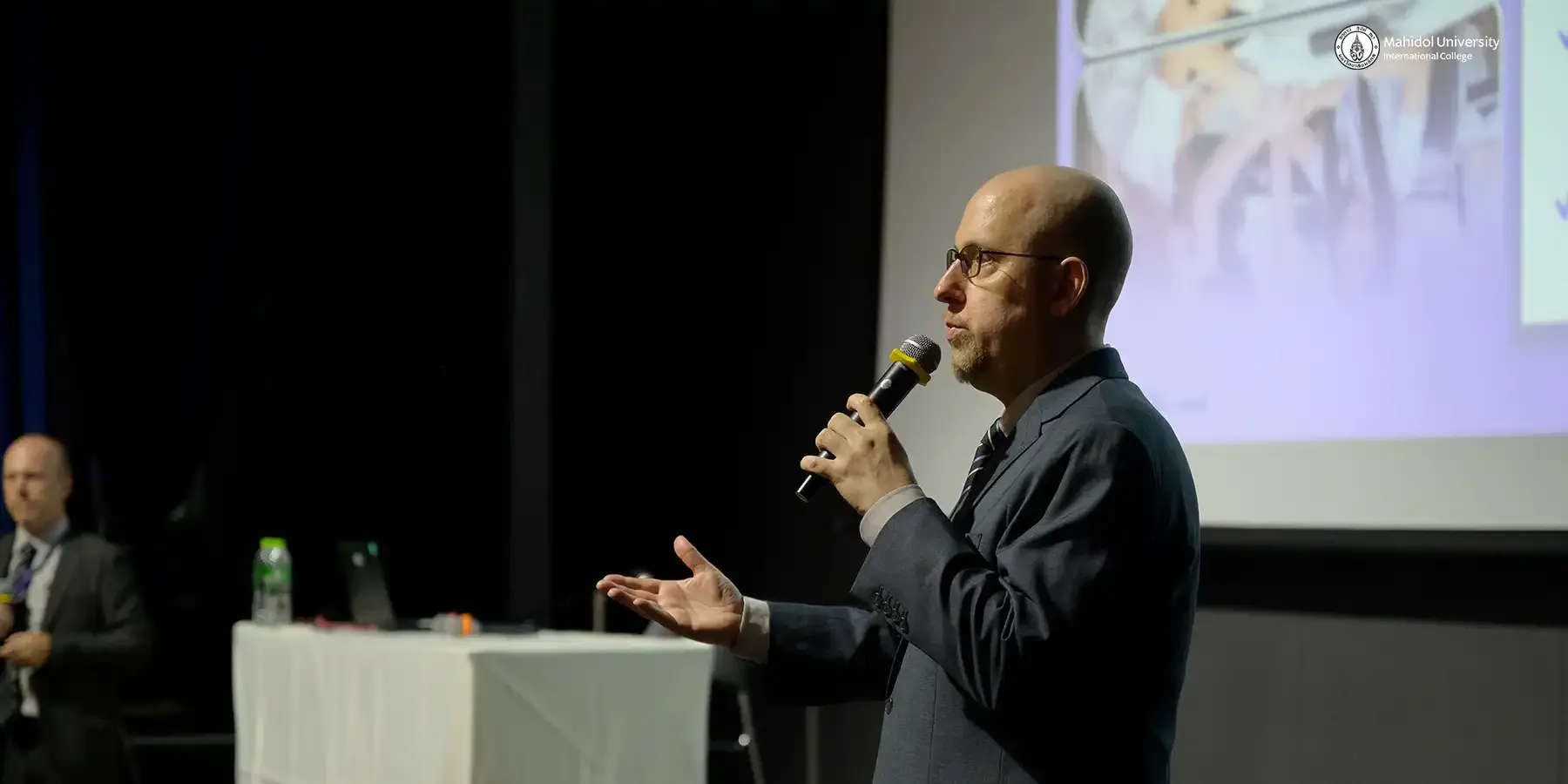
The Strategy and Academic Development Group organized the workshop entitled ‘Writing Teaching Cases I: Framing the Storyline’. This workshop aimed at guiding the faculties to develop a teaching case, frame the storyline, and publish the writing in the journal.
To begin with, the case method involves two combinations: the case itself and its discussion. A case is a story about people, organizations, phenomena, etc. at a certain point in time that tells a story of what, when, where, why, and how. A teaching case is intended for teaching purposes in which a group of students or individuals make decisions or solve a problem and produce a rich narrative. While the case provides information, the analysis of relationships among events, defining the options, taking decisions, and envisioning the future effects of their actions toward the case are carried out by students during classroom discussion. The case method is extensively used in business schools around the world and has become a trademark of top business schools as one means of nurturing problem-solving skills, the most in-demand skills of tomorrow.
Aside from being intellectually challenging, teaching cases enable students to achieve many learning objectives, such as analytical thinking, reading comprehension, discussion, communication, presentation skills, and interpersonal skills. Through the case method, not only do students gain more practical perspectives, but they also develop an inquisitive mindset, including the ability to articulate and apply various concepts, frameworks, and theories from their classes to tackle the key issues. At the same time, the lecturers who author the teaching cases can publish their cases, use the teaching cases towards academic titles, get good resources for curriculum development and assessment plans, and develop industry-academic networks.
To write a teaching case, the lecturer needs to map the case framework into three elements: who will be the case researcher or writer, what is the focal organization or community that will be used as a case, and what are the focal issues or problems that will be tackled? The writer needs to have an interest in the focal issues and possess the skills to weave a description into an interesting story. The focal organization must be aware of its own issue and be cooperative with a writer during the data collection period. For the focal issues, the writer needs to do a needs assessment to determine the organization's needs, identify or establish an issue or problem, and determine if it is appropriate for the intended course and for teaching the relevant concepts and theories.
The teaching case has a distinctively literary style: narrative style, in the third person, in the past tense, and using flashback technique. A case typically consists of three main parts: the opening paragraph, the main body of the case, and the closing section. The opening section draws a picture of the main issue and describes the context within which the case occurs; the principal protagonist, case timeline, and cut-off date. It’s basically where we provide a summary of the five questions (what, who, when, where, and why) posed by the interviewer. The main body of the case tells the whole story in chronological order. It provides general background on the business environment, company background, and details on the problems the company is facing. The way the story is told is often more important than the story itself. To engage the reader, tell more than one side of the story to provoke students to think of competitive alternatives, craft the story mode to give off the dynamic tension vibe, and use quotations when citing the story from interviewees or stakeholders of the cases. The last paragraph or the closing section should exude a sense of urgency, acknowledging that change is necessary to solve the problem, and providing a short synthesis to ingeminate the issue.
The reason why a university professor should write teaching cases is, after all, to practice what they preach, to improve knowledge and skills, to strengthen their academic profiles due to the publication of written documents in well-recognized outlets, and to develop industry-academic networks that further enable continuous curriculum updating and development, the growth of research collaborations, internships, and recruitment. In the classroom, the major advantage of case teaching for students is that the focus is on learning about real-world issues and solving them as they unfold. Moreover, students are spurred to identify problems, differentiate major issues, discover business patterns, and practice problem-solving skills.
Teaching cases is a powerful tool for teaching and learning business subjects. It’s a question-oriented approach that empowers students to be part of the decision making process and the solution by incorporating real-world problems into the classroom. Lecturers can use the teaching case to serve the course’s learning objectives, and get their work published as the basis for academic ranking requests. Additionally, the teaching case must be written in such a way that students learn that there’s no such thing as a “one size fits all” mentality or “single solution” to business problems. It is important to remember that ‘teaching case’ doesn’t come knocking on your door and ready to be used, but rather it’s a project that needs to be strategically planned, tailored, and executed to ensure its impacts on both students and lecturers themselves.